
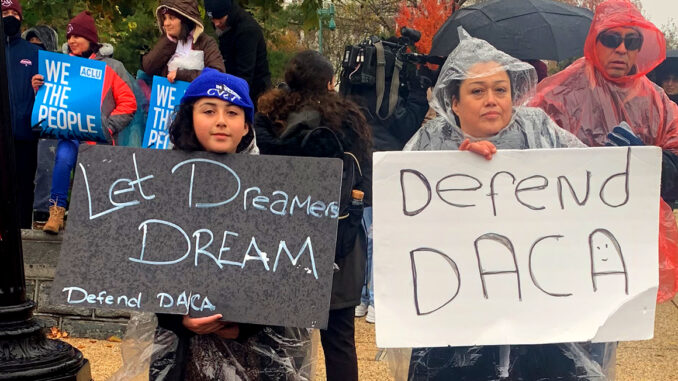

Most polling shows strong majorities of Americans oppose deporting people who were brought to the United States as children.
Diego Acevedo’s family brought him to the United States from Mexico on a tourist visa when he was only 2 years old, seeking better health care for their toddler as diabetic comas put his life at risk.
Acevedo’s visa expired months later, but his family stayed in the United States. Although Acevedo didn’t have legal immigration status, he managed to attend a private high school on scholarship and study communications at Santa Clara University in California. Now, at 22, he has graduated from college, moved back home and found a job at a marketing agency with a work permit he received through former President Barack Obama’s Deferred Action for Childhood Arrivals program.
Under the DACA program, the government defers deportation of undocumented immigrants who came to the United States as children and meet certain requirements, such as graduating from high school. It provides no legal immigration status or access to public benefits, but it does provide work permits that allow DACA recipients to gain legal employment. Those recipients must apply to renew their authorization and work permits every two years.
But the stability Acevedo has worked so hard for could vanish in a matter of months: He is one of thousands of Americans impacted by lengthy DACA processing delays under President Donald Trump’s administration.
Immigrant advocates say increased vetting by the Trump administration, which for years has tried to legally kill the program, is resulting in long renewal delays that are causing DACA recipients to lose their jobs when their work permits expire before they have received new ones. The delays are also causing DACA recipients to lose their driver’s licenses, advocates say
‘We are receiving calls every day from people who say they are not receiving their DACA authorization on time,’ said Anita Enciso, program director at the Arizona Dream Act Coalition, an advocacy group that helps people with DACA and renewal applications.
Before the administration implemented changes, most DACA renewal applications took about two months and often were processed in less than a month, Enciso said. Now, DACA recipients are waiting five to six months or longer. Some people who applied for renewal as far back as November still have not been processed, she said.
Data from U.S. Citizenship and Immigration Services backs that up, showing that median wait times for DACA renewals have jumped from two weeks in 2025 to more than two months in 2026. Democratic lawmakers say wait times are at their highest since 2016, when technical issues disrupted the system.
USCIS is not processing new DACA applications during a battle over the program’s legality.
The Trump administration appears to be applying extra scrutiny to DACA recipients as part of efforts to deport as many immigrants as possible under its aggressive mass deportation campaign, Enciso said.
In the past, USCIS rarely required DACA recipients seeking renewal to submit new biometric information, such as photographs and fingerprints. But under tougher new screening and vetting implemented by USCIS in 2025, nearly all renewal applicants are being asked to submit updated biometrics, adding to the delays, she said.
What’s more, USCIS has stopped accepting personal checks or money orders to cover the $555 renewal fee to apply online or the $605 fee to apply by mail plus an $85 biometrics fee, Enciso said
USCIS is ‘safeguarding the American people by more thoroughly screening and vetting all aliens,’ agency spokesperson Zach Kahler said in a statement.
Work permit expiration creates ‘incredibly big challenges’ for immigrants with DACA, said Julia Gelatt, associate director of the U.S. Immigration Policy Program at the Migration Policy Institute, a nonpartisan, nonprofit research center.
Employers are increasingly jittery about keeping employees on their payroll who don’t have valid work permits amid the Trump administration’s immigration crackdown, Gelatt said.
Some DACA recipients from countries such as Venezuela cannot apply to renew their DACA authorization or work permits at all under a travel ban the Trump administration implemented in 2025 that covers 39 countries, she noted.
Under President Joe Biden, USCIS eliminated huge backlogs in processing immigration benefits by increasing efficiency, Gelatt said. The Trump administration is now creating backlogs again with the increased vetting, she said.
USCIS has always tried to balance ensuring the integrity of the immigration system with helping employers and immigrants get through it in a timely way, Gelatt said, but ‘the Trump administration has tipped the balance.’
As of September, about 506,000 immigrants were approved for DACA, according to the Migration Policy Institute. Most are in their 30s or older. They have some of the highest levels of public support of any undocumented immigrant group: Most polling shows strong majorities of Americans oppose deporting people who were brought to the United States as children.
Democrats have accused Trump of slow-walking the renewals.
The administration has been ‘hostile’ toward immigration, Rep. Greg Stanton, D-Arizona, said May 11 at a news conference. ‘The fear that that puts in them, the uncertainty for them and their families, is bad for them and it is bad in this country
At a May 12 news conference, Sen. Mark Kelly, D-Arizona, highlighted the case of Annie Ramos, a DACA recipient and college student who was detained by immigration authorities in April, days after her wedding to a U.S. soldier.
‘In what world does it make sense for us to focus our time and our effort, chasing down and holding people like Annie? We should be chasing down serious criminals,’ Kelly said.
The processing backlog ‘seems intentional,’ he continued, and ‘leaves hardworking people, who have done everything right, in limbo.’
Acevedo’s DACA status is scheduled to expire in September, two days after his 23rd birthday. He applied for renewal nine months early, bracing for disruptions by the Trump administration. So far, he has heard nothing. ‘How can I have some sort of certainty when I have no stable foundation?’ he said.
Be the first to comment