

SANTA MARIA, Calif. – Few people have as much reason as farmworkers to celebrate the contribution their labor makes. As they often say, “Without us, you have no food on the table.” Yet few have as much right to protest the conditions under which they work.
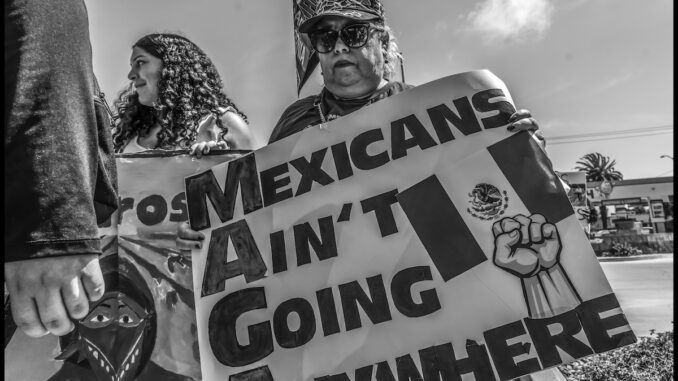
That contradiction brought farmworkers and supporters onto the streets of California’s Central Coast this past Friday in commemoration of May Day.
Among the hand-drawn placards carried by families and activists who joined in the march, the most popular were those condemning immigration raids. “MAGA – Mexicans Ain’t Going Anywhere,” proclaimed signs in giant lettering. “Fighting for the Ones Who Fought for Us!” read others, carried by young people defending their undocumented parents who feared that marching in public could expose them to arrest by Immigration and Customs Enforcement (ICE).

“May Day is our resistance to the kidnapping of community members and separation of families,” explained Fernando Martinez, organizer for the Mixteco Indigenous Community Organizing Project (MICOP). “Immigration enforcement has hit Santa Maria hard this year, and even though farmworkers are the backbone of our county, they’ve been hurt the most.”
May Day’s defiance of raids here has its roots in the immigrant uprising of 2006. That year millions of people turned out on May Day to successfully block Congress from making the lack of immigration papers a federal felony. Those massive marches recovered May Day from the legacy of the Cold War, when it was baited as the “Communist holiday,” and few people dared to publicly celebrate it, at least in the United States.


People immigrating to the U.S. from Mexico or the Philippines, however, already knew from the experience in their communities of origin that celebrating the workers’ holiday could be a vehicle for protesting exploitation. As May Day demonstrations spread in the years that followed, immigrant communities began using the day to make their own protests.
Santa Maria and neighboring Oxnard have had May Day marches for several years, based in immigrant farmworker communities and organized by MICOP and CAUSE, the Central Coast United for a Sustainable Economy. 805 Undocufund, founded to defend against the raids, joined along with other community groups, and this year May Day marches spread to two other central coast cities.
One is Paso Robles, where Mexicans furnish the labor for high-end wineries. The other, Lompoc, was a tiny town in the 1940s when its main street was lined with card rooms. Single Filipino men were the bulk of farm laborers then, famous card players who lived in Lompoc’s labor camps. Today what’s now a small city is the heart of California’s flower industry, and its strawberry fields are expanding to rival those in Santa Maria and Salinas.


Erica Diaz-Cervantes, policy director for CAUSE, was assigned to help organize the Lompoc march. Over 500 people filled the streets. “This is historic,” she said. “It’s never happened before. But students have seen their parents kidnapped by ICE, and like everywhere, families are being pushed to the wall. It’s not unusual for people to have to choose between buying food and paying the rent at the end of the month.”
Claudia Caceres, whose online platform Tu Tiempo Digital reaches the coast’s Spanish-Speaking community, recently organized a community meeting to provide food to hungry families. Seventy people registered and twice that number came.
“Santa Barbara County ranks second in poverty in the entire state,” she explained. “And when all the ICE raids and price increases began last year, everything became much worse. In 15 years I have never seen so many people asking for help and food. There are now many moms left alone with their children because their husbands have been arrested.”
This crisis is exacerbating already endemic poverty among Santa Maria farmworkers, documented in a powerful 44-page report, Harvesting Dignity, The Case for a Living Wage for Farmworkers. It revealed that the mean hourly wage for farm labor in Santa Barbara County was $17.42. That would produce a yearly income of $36,244 for a strawberry picker working fulltime, all twelve months.
In reality, annual income was much lower because even working the entire season, workers get no more than eight months of work, and often there are not enough berries for 8 hours each day.


That was the case for Mathilda, who when interviewed last year explained that she only got 36 hours a week, including Saturdays. Even fulltime work at minimum wage for eight months only produces $21,760, she said. During the May Day rally another farmworker, Jorge Ruiz, said his rent for a small apartment was $2000 a month or $24,000 a year. With two people in his family working, there’s hardly enough money left for food and other necessities.
The need to work is so great that Caceres felt she could not urge people to stay off the job on May Day, as the national campaign urged in protest against the abuses of the Trump administration. “How are you going to tell a person [not to work] who needs that work and money for their family?”
Martinez of MICOP understands that. “The harsh economic impact puts a huge burden on workers to come out for May Day. The cost of living has gone through the roof, which makes it hard to organize, and many farmworkers cannot afford to skip a day of work. But some do, who have the heart and the passion to organize.”
Ruiz was among them. “If we miss a day of work, it is difficult for us,” he said. “Many people are afraid of being absent. But if we don’t raise our voices, so they can hear we have the right to be paid better, it won’t change.”
People are afraid, and in tight communities like Santa Maria and Lompoc, almost everyone knows a family where someone has been picked up. That put a stop last year to the common practice by strawberry pickers of halting work at the beginning of the season, to pressure growers to raise the piece rate for picking.


“In the last few years these organic strikes had a positive impact,” Martinez said. “By 2020, workers were able to drive up the price per box from $1.80 to $2.10, a 30 cent increase. Now it’s at $2.30. That didn’t happen by magic. It happened because workers organized and pushed their employers to negotiate.”
But when raids make workers afraid to take that kind of action, the rate can fall, making an existing economic crisis for families even worse. Caceres believes the answer is “sending emails to the government, to congressmen, to senators, lobbying, going to meetings of the city of Santa Maria, to the county boards, complaining to our rulers who represent us.”
That, in fact, has been a program of MICOP and CAUSE, who have asked Santa Barbara supervisors to mandate a $26/hour minimum wage for farmworkers. Workers have testified at Board meetings, but growers have threatened to relocate agricultural production to other countries.

Among this year’s hot election contests, one might tip the Board’s balance in favor of the proposal. CAUSE and its allies are walking door-to-door for Ricardo Valencia, a high school teacher with strong support from farmworkers. Republican Cory Bantilan has raised a lot of money, but even in Santa Maria, being a Republican in 2026 might be a problem. Santa Maria City Councilmember Maribel Aguilera-Hernandez is Valencia’s more serious opponent.
According to the US Department of Agriculture, only a third of U.S. farmworkers are citizens, and close to half are undocumented. Most estimates say a much larger percentage in California lack papers. While undocumented workers can go door-to-door in elections, and some unions mobilize them to do so, marches like those on May Day are a basic way to insert themselves into the political process.
As Ruiz says, the point is to have a voice.
Be the first to comment