

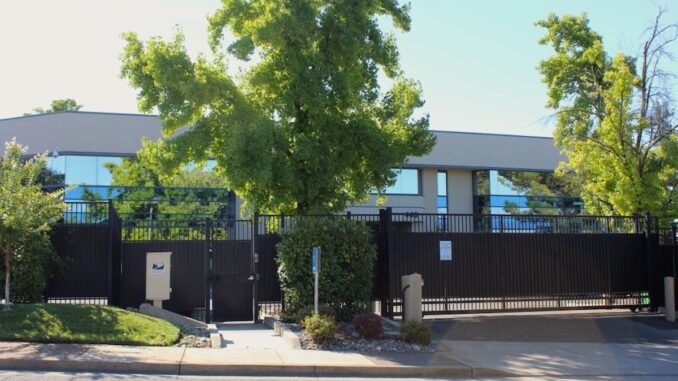

REDDING, Calif. — An Immigration and Customs Enforcement (ICE) facility in Redding, about 160 miles north of Sacramento in largely rural Shasta County, has been detaining noncitizens for years, federal government data shows.
The data also indicates that the rate at which immigrants were being detained at the facility significantly increased after President Donald Trump was inaugurated. Only about half of those detained since then have had a criminal record.
Last summer, Shasta Scout broke the news that Redding has an ICE facility, something that local officials — including the police chief and former city manager — said they knew little to nothing about. At the time, Scout could not verify whether the facility, located at 443 Redcliff Drive, was actively detaining people or what the facility’s operations were. ICE officials did not respond to requests for comment on the specificities of the facility, but records requests confirmed the existence of holding cells.
There’s been ICE activity in Redding since at least 2012, according to documents obtained by Shasta Scout last summer. The first confirmation of ICE owning the Redcliff Drive building was documented the year after. It’s still unclear why no record of such a facility is listed on ICE websites, even now.
Federal data obtained by the Data Deportation Project late last year and reviewed by Shasta Scout shows there have been hundreds of detainments in the facility since 2019. More than half occurred during the first nine months of Trump’s second term.
That data uses the term “Redding Hold Room,” although the Redcliff Drive building isn’t listed publicly by ICE as a place to detain immigrants. Hold rooms are different from ICE’s detention centers in that they’re not subject to scrutiny by state officials and were only designed to hold people for a few hours. Immigration law experts have concerns about these facilities due to increasingly extended hold times and reports of inhumane conditions in some facilities.
ICE officials did not respond to repeated requests for comment for this story.
Where did the data come from?
The Deportation Data Project is a database containing U.S. immigration enforcement data gathered through records requests to ICE and other federal government agencies, meaning all of the data is sourced from the government itself. The database is compiled by researchers based at the University of California campuses in Berkeley and Los Angeles who are actively seeking ongoing updates to these datasets. The latest release of data — which contains records up to mid-October 2025 — was posted last December.
For the most accurate and consistent analysis, Shasta Scout primarily reviewed data from the latest batch release, which includes records dated from September 2023 to October 2025.
Detainments surge in Redding as ICE activity expands nationwide
News outlet ChicoSol has reported that multiple noncitizens from nearby counties have been taken to the Redding ICE facility over the last year or so, including a couple of individuals who were taken there after being detained at court.
Overall, since 2019 — the year when ICE detainments were first reported at the Redding facility — there have been about 280 times when a noncitizen has been held in the Redding Hold Room.
During former President Joe Biden’s term, the highest number of detainments in one year at the facility was 28, the number held in 2024. Most other years, the number of detainments under Biden was only in the single digits. But with Trump’s second term came a more aggressive immigration agenda, which is reflected in Redding detainment numbers.
Between Trump’s arrival in office on Jan. 21, 2025 and mid-October — the most recent date for which the Deportation Data Project has obtained data — there were about 150 detainments at the Redding facility, making up over half of the total number of detainments since ICE started reporting holds at the facility. The majority of those detained were listed to be of Hispanic origin, and the vast majority were identified as male.
Last summer, the rate at which immigrants were being detained in Redding started to rise, echoing national trends. By June, the average number of people getting detained per month was 12, but that number doubled in July, August and September.

Part of the Trump administration’s immigration agenda has been to target the “worst of the worst,” terminology used to describe noncitizens with violent criminal convictions. However, both national and regional reports show that arrests of noncitizens without any criminal record have also been increasing. At the Redding facility during the first year of Trump’s second term, about half of those detained had no indication of a criminal record. Comparatively, in 2024 under Biden, only 20% of detainees at the Redding Hold Room had no criminal record.
The ICE data also includes other demographic information related to those detained, such as the noncitizen’s birth year. Of those detained in the last two years, the oldest person was born in 1956, and the youngest in 2006. Both were detained under Trump. The majority of those detained in Redding under both Biden and Trump were in their 30s and 40s.
The data also lists the country of citizenship of the person detained. In the last two years, the majority — about 83% — of immigrants held in the Redding facility were citizens of Mexico, followed by about 5% from China and 2% from Guatemala. Other countries of citizenship include El Salvador, Honduras, Colombia, Dominican Republic, Egypt, India, Ireland, Jamaica, Laos, Tonga, Turkiye, United Kingdom, Uruguay and Venezuela.
ICE data does not document the detainment of any U.S. citizens at the facility since it started reporting detainments in 2019.
What is a hold room?
Last October, The Guardian published an investigation about ICE facilities like the one in Redding, which it referred to as “secretive” hold rooms. There are at least 170 nationwide, according to data from the Deportation Data Project — including the one in Redding. The investigation found that some individuals held in the rooms were there for days or weeks at a time, the conditions inside the rooms were sometimes poor, lawmakers have been denied entry into such rooms for oversight inspections, and they’re not subject to traditional audits that larger ICE facilities are required to go through.
Hold rooms in detention facilities were originally meant to be places where people are held for a short period of time while they await further processing, according to an ICE policy document outlining standards for detention. They’re often small, concrete rooms located in ICE offices and federal buildings, and they don’t contain beds. After a stay in a hold room, individuals are usually released or transferred to a different ICE facility, which could be to another hold room or a detention center that is meant for longer-term stays.
ICE data shows individuals were most often transferred from Redding to other hold rooms in Sacramento, Bakersfield, Santa Ana and San Pedro, as well as to ICE detention facilities, such as the Golden State Annex in McFarland and the Mesa Verde ICE Processing Center in Bakersfield.
Before last summer, it was against ICE’s standards to detain someone in a hold room for more than 12 hours. But after it was revealed that ICE had begun detaining immigrants in hold rooms for much longer than the maximum allowed time in some states — likely because of the major influx of immigrants being arrested and detained under Trump — ICE sent a memo to field offices toward the end of June 2025 extending the limit to 72 hours.
After Trump was inaugurated, the average length of stay in the Redding Hold Room was about 9 hours, but there were 42 separate instances where an individual was held over 12 hours. The longest someone was held was during September 2025, for more than 82 hours or about three and a half days.
Immigration attorneys express concern over ICE’s hold rooms
Nisha Kashyap, an attorney and director of the Racial Justice program at the Lawyers’ Committee for Civil Rights of the San Francisco Bay Area, told Shasta Scout it’s very concerning that people are being held for days on end in rooms that were only meant to hold people for a few hours.
“It’s common sense and to be totally expected that if you’re holding people overnight and for multiple days there,” Kashyap said, “there are basic human needs that you’re going to need to meet, and if ICE is unable to meet those needs, as we’ve seen, it results in these inhumane and unconstitutional conditions.”
Immigrants who are detained in the U.S. have constitutional rights, including the right to not be punished by the conditions they are kept in while detained, the right to due process and the right to legal representation if requested, Kashyap said.
While the conditions inside the Redding Hold Room are still unknown, Kashyap said it’s still a concern that people are being held for more than 12 hours at a time. She said ICE’s standards for hold rooms are lower than they are for longer-term detention facilities, and there’s little oversight of the rooms because ICE often denies lawmakers and attorneys access to the rooms, causing a lack of transparency about what’s going on inside.
Kashyap has represented multiple noncitizens who were detained in hold rooms in San Francisco in a lawsuit alleging such rooms had unconstitutional and inhumane conditions. She said those detained there were often held overnight without anywhere to sleep, they were denied access to basic hygiene supplies and medical screening and care, the lights were usually on 24/7, the room itself was cold, and there was only one toilet to be used by all being held in the room.
The entire lawsuit is ongoing, as it also challenges the 72-hour hold room policy and ICE’s policies that permit arrests at immigration courts. But the argument challenging the conditions of the San Francisco hold rooms won, and the judge issued a preliminary injunction ordering ICE to comply with the Constitution by improving conditions at the facility. The attorneys in the lawsuit also filed motions asking the court to vacate ICE’s 12-hour waiver policy and the courthouse arrest policy nationwide.
Kashyap said she thinks violations of constitutional rights are likely happening in ICE’s hold rooms across the country. Another lawsuit has been filed in Baltimore, alleging inhumane conditions in hold rooms, including the denial of access to food, blankets, mattresses, showers and medical care.
Amelia Dagen, an attorney with the Amica Center for Immigrant Rights and the lead attorney on that case, told Shasta Scout that she began hearing instances of people being held in poor conditions in these hold rooms for days on end since very early last year. She said the conditions she’s litigating in Baltimore are very common in other jurisdictions from what she’s heard of cases across the country related to ICE’s hold rooms.
“I think these conditions are being maintained by ICE nationally because it’s a matter of national arrest quotas and national enforcement priorities that are so high,” Dagen said. “Because there’s this ramp up in enforcement activity, there necessarily has to be an increase in detention.”
The office of California Senator Adam Schiff, who recently conducted oversight at an ICE detention center in California City with Senator Alex Padilla, said in an email statement that it is aware of the Redding ICE facility and is concerned about the facility’s conditions and those who are held in it. The office stated that it’s been working with local, state and federal leaders to express concerns about the conditions and mistreatment at these detention centers in California but did not provide further details about the Redding facility.
Be the first to comment