
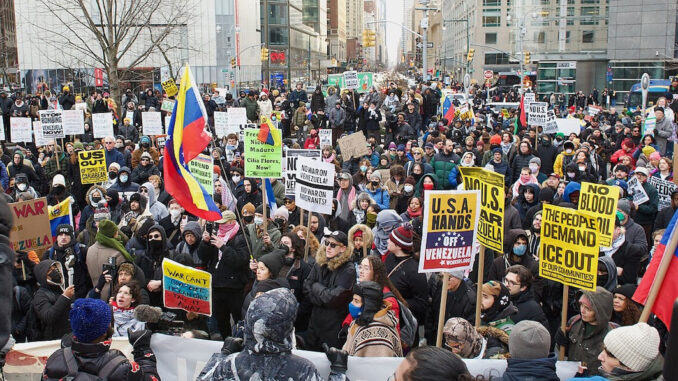

Venezuelans danced in the streets of Miami the day after U.S. forces abducted President Nicolás Maduro. Iranians in Los Angeles marched in support of Reza Pahlavi, the son of the former Shah, on the cusp of the U.S. war with Iran.
At the same time, the Trump Administration’s domestic agenda is straining support in communities once seen as staunchly anti-Communist and pro-Republican.
From aggressive immigration enforcement policies to cuts to healthcare, experts during an ACoM virtual briefing shared perspectives on how diaspora communities — from Venezuelan and Cuban to Iranian and Asian American — are navigating our current political moment.
Cuba on the brink
Eduardo Gamarra, a professor of politics and international relations at Florida International University (FIU) who has studied Latin American diaspora communities for four decades, pointed to the case of Cuban Americans, who rallied behind a president running on mass deportation despite being the beneficiaries of the Cuban Adjustment Act of 1966, which has granted them preferential permanent residency status.
Gamarra said he now sees fractures growing in this alliance, as Cuban Americans who voted for Trump are seeing cuts to Obamacare — Miami and Hialeah lead the nation among the highest per-capita users of the program — while watching relatives deported not to Cuba but to third countries like Uganda and Ecuador.
The FIU Cuba Poll, the longest-running survey of Cuban Americans in the country, found that in October 2024, 68% of likely Cuban American voters in Miami-Dade County said they would vote for Trump — an all-time high since polling began in 1991.
Yet, while 55% of registered Cuban American respondents were Republicans, only 38% of those born outside of Cuba were registered Republicans.
Meanwhile, three months after the U.S. capture of Maduro — who had close relations with Cuban leadership — Cuba suffered three nationwide electricity blackouts in a week amid a U.S oil blockade.
Trump, who has demanded that Cuba liberalize its government and economy and release its over 1,000 political prisoners in return for a lifting of the sanctions, has told reporters that he believes he would have the “honor” of taking Cuba.
Venezuelan support for Trump wavers
The same split among Cuban Americans is also emerging among Venezuelans.
FIU polling from 2025 found that about half of Venezuelan Americans who voted for Trump in 2024 were “very or somewhat satisfied with their vote,” with longer-term immigrants feeling more aligned with Trump’s policies than newer arrivals.
The poll also found that roughly 70% of those who said they wouldn’t vote for Trump again have a relative with Temporary Protected Status (TPS) or humanitarian parole.
“This gives you a sense of how this policy has changed” political alignments, Gamarra said.
On the question of U.S. foreign intervention, he said Trump’s handling of Venezuela following Maduro’s ouster is also giving some Venezuelans pause.
The Trump administration appears to be accommodating Venezuela’s existing power structure — including its detention apparatus, which holds over 500 political prisoners — in exchange for oil access.
On March 18, Venezuela’s interim president Delcy Rodriguez replaced Vladimir Padrino Lopez, who had served as defense minister for over a decade under Maduro, with Gustavo González López, Venezuela’s domestic intelligence director who has been sanctioned by several countries due to human rights violations and corruption.
“One of the things that we keep getting in numerous countries is the idea that the worst ally of all is the United States, because you can’t trust them to keep a promise for the long term,” Gamarra said.
The Iranian American political wager
Unlike Latino diaspora communities, Iranian Americans exercise political influence disproportionately through money rather than concentrated votes, said William O. Beeman, professor emeritus of anthropology at the University of Minnesota.
Since the 1980s, the U.S. Iranian American population has grown fourfold as immigrants arrived fleeing the Islamic Revolution and the Iran-Iraq war. As of 2024, there are about 740,000 Iranian Americans in the U.S., with nearly half — 375,000 — living in California, mostly in Southern California.
Iranian immigrants constitute one of the wealthiest and highest-educated U.S. immigrant groups. About 79% of Iranians aged 25 and older had at least some college education in 2024, compared with about 58% of other U.S. adults, according to Pew.
Beeman traced the Iranian diaspora’s historically Republican political alignment to the 1978-79 revolution, when three competing factions — secular liberal royalists, Islamic Marxists and Sharia Islamist clergy — united against Shah Mohammad Reza Pahlavi. The conflict resulted in the establishment of an Islamic Republic under Ayatollah Khomeini.
When Khomeini consolidated power with the loyal Islamists, the other two groups splintered and fled the country.
Beeman explained that both remaining factions — royalists hoping for the return of Reza Pahlavi, son of the exiled Shah, and the Mujahideen-e-Khalq, a paramilitary group with Marxist roots — have found support among Republican politicians including, in the case of the Mujahideen, former United Nations Ambassador John Bolton, former Kansas Governor Sam Brownback and former Florida Congresswoman Ileana Ros-Lehtinen.
The appeal, in Beeman’s view, was tactical: “They would be the cat’s paw. They would be the people who could actually go in with some kind of paramilitary group and overthrow the government, and then the United States would deal with them, because they’re relatively small.”
As for the return of Reza Pahlavi, Beeman was skeptical.
“The idea that he could somehow be installed as a monarchical ruler in Iran is a little bit of a fantasy, because although he has support here … he doesn’t have the support of the Iranian people,” he explained.
The long history of Asian exclusion
Journalist and Asian American civil rights activist Helen Zia offered the longest historical lens, going back 150 years to the Chinese Exclusion Act of 1882 and the Page Act of 1875. These laws barred Chinese and later all Asian immigrants from citizenship and political participation for decades.
“The Chinese and Asian diaspora were the first to be excluded” on the basis of race and nationality, Zia explained, setting a template that has never fully disappeared.
She emphasized “the use of diaspora communities as pawns” when U.S. foreign policy demands a scapegoat — from the surveilling of South Asians suspected of terrorism after 9/11, to the targeting and firing under the Justice Department’s China Initiative of hundreds of Chinese-American researchers alleged to be spies, to the rise in anti-Asian hate crimes related to the COVID-19 pandemic.
“When U.S. Asian policy develops a sniffle or cold, Asian American communities get pneumonia,” Zia said.
“The violence that’s going on, whether it’s in Iran or Venezuela or starving Cubans to death, has a spillover to every community,” she added. “It’s going to be used to divide us and to pit us against each other … This is a pattern that has gone on since the creation of this country.”
Be the first to comment