
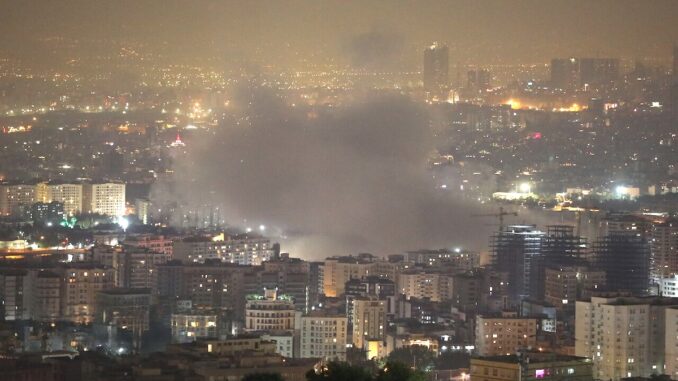

I find myself returning to Leo Tolstoy’s War and Peace these days — almost instinctively, as if the novel’s vast emotional terrain offers clarity in a moment when the world feels unsettled.
Tolstoy wrote about Russia’s struggle against Napoleon, but what stays with me is not the battles; it is the quiet, human cost of conflict. His characters live through uncertainty, fear, and the reshaping of their lives by forces far beyond their control. As tensions escalate once again in the Middle East, I cannot help but see echoes of Tolstoy’s world in the lives of millions of migrant workers who now find themselves caught in the crosswinds of geopolitics.
Tolstoy understood that war is never just a clash of armies. It is a disruption of ordinary life. In War and Peace, the grand strategies of generals coexist with the intimate anxieties of families: Pierre’s search for meaning, Natasha’s longing for stability, Andrei’s struggle between duty and despair. These characters are swept into events they did not choose, yet they must navigate the consequences with dignity and resilience.
Echoes of Tolstoy in Today’s Middle East
Today, migrant workers across the Middle East—Filipinos, Indians, Bangladeshis, Nepalis, Sri Lankans, and Africans—live in a similar tension. They are not combatants, yet they are among the most vulnerable when conflict erupts. The region is home to millions of foreign workers who sustain its hospitals, construction sites, households, ports, and service industries. Their labor keeps economies running, but their safety is often precarious.
When missiles fly, when borders tighten, when governments issue evacuation advisories, migrant workers face impossible choices: stay and risk their lives, or leave and risk losing the income that supports their families back home. Tolstoy’s characters often confront the same dilemma—survival versus responsibility, fear versus duty.
For Filipinos, this dilemma is deeply personal. The Philippines has long relied on overseas workers, especially in the Gulf, where remittances support entire communities and stabilize the national economy. A sudden repatriation order, while necessary for safety, can mean the collapse of a family’s financial lifeline.
The Fragility of Livelihoods in Times of Conflict
Many Overseas Filipino Workers (OFWs) have loans to pay, children in school, or relatives dependent on their monthly remittances. Tolstoy wrote that “the strongest of all warriors are these two—time and patience,” but for migrant workers, time is uncertain, and patience is often a burden they cannot afford. The same is true for Indian, Bangladeshi, and African workers who form the backbone of Gulf labor markets. Many have borrowed heavily to secure their jobs abroad.
Returning home prematurely can plunge them into debt, unemployment, and social stigma. In War and Peace, Tolstoy describes how war exposes the fragility of human plans. Today, migrant workers live with that fragility in real time, with every news alert or diplomatic escalation threatening to upend their lives.
Citizens Caught in the Crossfire
But it is not only migrant workers who suffer. Citizens of the countries directly involved in the conflict endure the most devastating consequences. In Gaza, entire neighborhoods have been reduced to rubble, families displaced multiple times, and necessities — water, electricity, medicine — have become scarce. Ordinary people, who have no say in political decisions, carry the heaviest burden of war. Their lives mirror Tolstoy’s civilians who flee burning villages, clutching whatever they can carry, unsure if they will ever return home.
Across the region, from Lebanon to Israel to Yemen, civilians face the same uncertainty. Parents worry about their children’s safety, students see their futures interrupted, and workers lose their livelihoods overnight. These are the human stories that Tolstoy would have recognized instantly: the quiet heroism of survival, the grief of loss, and the stubborn hope that peace might still be possible.
The Immigrant’s View From Afar
Migrant communities in the Middle East experience this same emotional burden. A missile strike hundreds of miles away can send waves of panic through WhatsApp groups. A sudden shift in alliances can trigger fears of border closures or mass evacuations. The psychological toll is real, even if it rarely makes headlines.
As immigrants in the United States, we watch these events with a unique mixture of distance and intimacy. We are safe here, yet emotionally tethered to those who are not. Many of us have relatives working in the Gulf, or friends whose families depend on remittances. We understand the sacrifices that come with migration — the long hours, the loneliness, the hope that hardship will lead to a better life.
When conflict threatens that hope, it becomes personal. Tolstoy believed that history is shaped not only by leaders but by the countless small decisions of ordinary people. In the Middle East today, the resilience of migrant workers is one of those quiet forces.
A Call for Protection and Compassion
They continue to work, to send money home, to pray for safety, to hold onto the belief that peace will return. Their endurance is a reminder that even in times of war, humanity persists. But endurance should not be mistaken for acceptance. As global citizens — and especially as members of immigrant communities — we have a responsibility to advocate for the safety and dignity of migrant workers.
Governments must ensure that repatriation plans are humane, that workers are compensated fairly, and that families are not left destitute. Host countries must protect foreign workers regardless of nationality. And the international community must recognize that the human cost of conflict extends far beyond the battlefield.
Tolstoy’s Final Lesson for a Fractured World
Tolstoy reminds us that peace is not a passive condition but a deliberate act of moral courage. In War and Peace, the characters who endure are not the strongest, but those who refuse to surrender their humanity even when the world around them collapses. That same quiet courage is visible today in the Middle East — in the families who shield their children from fear, in the workers who continue to labor with dignity, and in the citizens who cling to hope despite devastation. Their resilience is a testament to the human spirit’s refusal to be defined solely by conflict.
For those of us living far from the region, especially as immigrants in America, Tolstoy’s lesson is clear: distance does not absolve us of responsibility. We may not hear the explosions or see the rubble, but we feel the tremors through our families, our communities, and our shared humanity. The Filipino diaspora knows what it means to build a life through sacrifice, to send hope across oceans, and to pray for the safety of loved ones in uncertain lands. In moments like this, our role is to amplify compassion, demand accountability, and insist that the lives of workers and civilians — regardless of nationality — are not collateral in the ambitions of nations.
If Tolstoy were alive today, he might remind us that history is shaped not only by the decisions of leaders but by the moral clarity of ordinary people. Peace begins with the recognition that every life has equal worth, whether in Gaza, Tel Aviv, Riyadh, Manila, or New York. And so we return to his enduring truth: that in times of war, the most radical act is to insist on our shared humanity — and to work, in whatever way we can, toward a peace that protects the vulnerable, honors the dignity of labor, and refuses to leave anyone behind.
Be the first to comment