

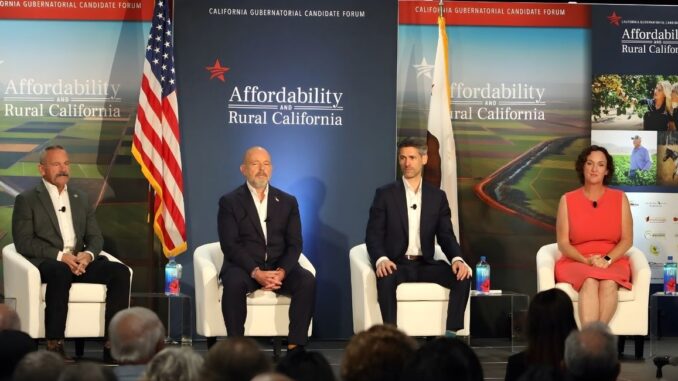

FRESNO, Calif. – In the race to take over the reins as governor of California, the world’s fourth-largest economy, the top candidates in a crowded field tried to stand apart from each other during two recent gubernatorial forums in Fresno.
Addressed to two distinct audiences separated along racial and economic lines, both events centered on the future of agriculture and the farmworkers who keep it going.
The first forum held April 1 at Fresno State University, titled “Affordability and Rural California,” centered largely around discussion of water for agriculture, regulations that harm farmers and energy needs.
Fresno sits in the heart of California’s Central Valley, where big ag plays a dominant role in the region’s economy and local politics. Farmers here have long bristled against the state’s regulatory framework, including limits on groundwater pumping and drought-fueled shortages.
Candidates — Republican and Democrat — scrambled to identify with the audience of about 500 at the Resnick Student Center, mostly farmers or business people, nearly all of them white.
“My great-grandfather was a farmer. My father was a farmer, and I am not. And that is because of what has happened to American agriculture,” said Katie Porter, one of eight Democrats vying to replace outgoing Gov. Gavin Newsom, widely considered a contender for the 2028 Democratic presidential ticket.
The same afternoon, five Democratic candidates addressed a diverse crowd of 400 — mostly Latinos, Punjabis and Hmong — at the Fresno City College auditorium. The event, the “Workers and Families of the Central Valley” forum, was organized by the UC Merced Community and Labor Center.
“I want the hardest-working and the lowest-paid to have California so they can live their dream. I do it because I was the son of immigrant workers,” said former U.S. Health Secretary Xavier Becerra.

A high stakes race
The stakes in the race are high as two Republicans – former FOX News host and businessman Steve Hilton and Riverside County Sheriff Chad Bianco – look to finish atop a June 2 primary field packed with at least eight viable Democrats that could see them qualify for the November general election.
In deep blue California, polling shows Hilton — a Trump-endorsed former FOX news host — at the top, with Bianco in third as concerns among Democrats grow that Republicans will consolidate support as Democratic voters dilute theirs.
Billionaire Tom Steyer, who has largely bankrolled his own campaign sits in second, with Rep. Eric Swalwell in fourth. Not far behind are Porter, former Los Ángeles Mayor Antonio Villaraigosa, and Becerra.
San José Mayor Matt Mahan, a late entrant but armed with major donations from Silicon Valley, is in single digits in the polls. Superintendent Tony Thurmond is also in single digits.
State law bars Gov. Newson from running for a third term.
GOP, Dems say ag is overregulated
Valley farmers, who have helped make agriculture a $61.2 billion industry, have long grumbled about lack of water, the state’s burdensome Sustainable Groundwater Management Act (SGMA), and a slew of other regulations they say is strangling their operations.
The gubernatorial hopefuls at the Fresno State forum agreed.
“It wasn’t farmers that ruined your industry. It wasn’t farmers that ruined the water industry. It wasn’t farmers that put all the regulations on yourselves,” said Bianco to applause. “It was all of these people (on stage), and it was their policies and it was partisan politics.”

Bianco, who currently serves as sheriff in Riverside County, recently garnered attention after his office seized 620,000 ballots tied to the 2025 election. The sheriff claimed to be investigating claims of voter fraud. Voting rights advocates say the move threatened to undermine election integrity. California Attorney General Rob Bonta sued, after which Bianco halted further investigation.
Mahan also blamed Sacramento for the farmers’ woes.
“For far too long, the interests of our ag economy and our rural towns and cities/communities have been second tier if they’ve even been on the agenda in Sacramento,” said Mahan, who stressed he grew up in Watsonville, an agricultural community along the Central Coast. “The truth is most of our policies are not working in practice. We have made it too difficult to expand infrastructure and water supply.”
Villaraigosa, making his second bid for governor, said California is overregulated. He mentioned finding out in Bakersfield that the cost for farmers went “from $160 an acre regulatory cost to $1,600.”
“That’s not sustainable. There actually is agreement that things are broken in Sacramento. It’s not just about partisanship,” said Villaraigosa. “It’s about people that never worked on a farm that think they get food from a box or a can and really don’t know what goes into all of it. We need to bring farmers into the regulatory environment.”
Martín Chávez is a farm management executive in Kings County. Leaving the event, he said Hilton was his clear choice.
“He’s actually showing up. He’s talking to people,” said Chávez. “He’s shown up to our workplace and actually spent a day with us seeing what some of the challenges we face in the ag community are.”
A focus on working families
The discussion at the FCC auditorium, meanwhile, focused on affordability and improving the conditions for farmworkers, the backbone of California’s ag sector and a population now besieged by the Trump Administration’s aggressive immigration enforcement policies.
Estimates suggest that between half and even as high as 75% of farmworkers in the state are undocumented. A majority live in low-income households.
Villaraigosa noted that California is expensive to live in, especially in the Central Valley where poverty ranks among the highest in the state. Education, he said, is the ticket out of poverty.
“We need to make college free in California. At a minimum, the CSU (state universities) have to be free,” he said.
California, with the world’s fourth-largest economy, can afford to help, the candidates agreed.
“I understand $274 billion to this economy is what immigrants bring,” said Villaraigosa, addressing the audience, “and we need to acknowledge that and treat them humanely.”
Nearly one-third of California residents are immigrants, including some 2.3 million undocumented individuals. Together they comprise around 8% of the state’s overall workforce.

Thurmond leaned into economic and housing issues.
“We have to make it possible for everyone here to live the American Dream again and to buy a home,” he said. “As governor, I will build 2 million housing units, provide down payment assistance programs and make sure that everyone has good-paying jobs.”
Referencing rising concerns over the displacement of workers by artificial intelligence, Becerra said AI should not displace workers but support them.
“Every time we have a leap in technology, people lose their jobs,” said Becerra. “So let’s not be fooled. We don’t have to repeat that history.”
Mahan offered a more sanguine take. “The truth is we have an incredible opportunity in California to lead the world in agricultural innovation,” he said, calling for greater investments in research and an “ecosystem of entrepreneurs.”
Be the first to comment