
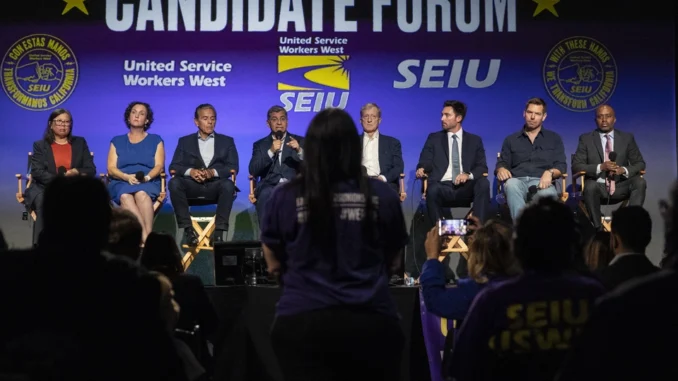

SACRAMENTO, California — Top Democrats passing on their state’s preeminent job. New candidates streaming in late. And a Republican upset threat so serious that the state Democratic Party pleaded with a fractured field to consolidate — and was promptly told to go pound sand.
Welcome to California’s most muddled gubernatorial race in a generation.
SACRAMENTO, California — Top Democrats passing on their state’s preeminent job. New candidates streaming in late. And a Republican upset threat so serious that the state Democratic Party pleaded with a fractured field to consolidate — and was promptly told to go pound sand.
Welcome to California’s most muddled gubernatorial race in a generation.
Polls paint a top tier of Democrats that includes Porter, Rep. Eric Swalwell and megadonor Tom Steyer. All three have plausible cases: Porter and Swalwell both built brands in Congress as she excoriated corporate leaders and he emerged as a leading anti-Trump combatant. Steyer, a billionaire, has socked tens of millions of dollars into his bid and worked to build inroads with organized labor.
“If you think about the three nominal front-runners, Porter and Swalwell both built their name recognition on being stars in Congress in different ways: a lot of MSNBC, a lot of viral moments on social media,” said Addisu Demissie, who ran Newsom’s 2018 campaign. “Steyer has done so in the more traditional California way, which is he’s bought it with spending and early spending in particular.”
Yet none of them have unified the party or the left-leaning interest groups, like unions, that hold outsize sway over Democratic politics but have either scattered or delayed planned endorsements because they’ve been unable to settle on a candidate. While Newsom is preparing for a likely presidential run, there is no heir apparent.
“We are coming out of Newsom and Jerry Brown and (Arnold) Schwarzenegger — that’s three governors in a row who had large national and statewide profiles going into this race, versus a bunch of people none of whom have anything approaching that,” said Demissie.
Elected officials and political consultants said that the vacuum reflected larger political dynamics. A long era of Democratic dominance has sharpened internal power-jockeying.
“You used to wake up and there was a Republican governor, and that had a unifying power,” said political consultant Elizabeth Ashford. “If you’re not dealing with opposition all the time then there’s diversity inside the entity that has power.”
At the same time, a fractured media ecosystem and the erosion of institutional powerbrokers, like party leaders, have decentralized the state’s politics and created more avenues for upstarts to break through. Everyone is theoretically one viral moment away from liftoff.
“Now you have an arena where you have a large number of legitimately qualified individuals running but there’s no apex predator,” said Bill Wong, a longtime California political consultant. “You’re talking about a voting population that is getting their information from a lot of different sources, they’re not as party loyal as they used to be, and there aren’t the kind of party-loyal institutions out there that dictate where significant chunks of voters go.”
Boxer explains it like this: “Everyone’s sort of an entrepreneur in their own political ambitions. You don’t really have a machine where people say, ‘Well, this one endorsed me, so everyone else get out.’”
That shift is especially stark in San Francisco. The resolutely blue city has been a locus of both statewide and national political power, producing an intertwined lineage of Democrats like Brown, Newsom and former House Speaker Nancy Pelosi. But there is a pervasive sense in political circles now that that era has passed.
“The state was dominated by a San Francisco political family that has withered,” said political consultant Eric Jaye, who is advising Mahan and in the past worked for Newsom and then Villaraigosa. “There was a political dynasty that came out of this town and bred superstars, and it faded.”
Not everyone thinks that’s a bad thing. The lack of a field-clearing front-runner opens the space for a real debate about the Democratic Party’s future, said California Environmental Voters CEO Mary Creasman.
“I think it’s exciting,” Creasman said. “It’s good to have a year where there’s no anointed top candidate. I think we need the competition on the issues.”
But some take a more cynical view. Lt. Gov. Eleni Kounalakis, who entered the governor’s race soon after Newsom won reelection but shifted to running for treasurer, said in an interview that a cold calculus of viability overrode other considerations.
“The underlying question of who would be a good governor is secondary to whether you have name recognition and the ability to buy name recognition,” Kounalakis said.
Statewide campaigns are prohibitively expensive to run in California. That elevates the clout of deep-pocketed donors who can stock outside committees without contribution limits, like a tech-backed PAC buoying Mahan — and gives struggling candidates a reason to stay in the hunt if they believe they’re one big benefactor away from catching fire.
“Typically money and name identification identify the front-runners, but given the emergence of numerous independent expenditure committees, the threshold for viability shifts,” said former state Sen. Steve Glazer, who ran Brown’s campaign. “If you’re polling at 2 percent but think there’s $20 million out there for you, it makes it harder” to drop out.
Under California’s primary system, in which the top two vote-getters advance to the general election regardless of party, the standard play for Democratic front-runners is to try and engineer a general election romp by drawing a Republican opponent — a move that requires the resources to target your closest Democratic competitor while boosting the leading Republican.
But that tactic is “extraordinarily difficult” to execute with a field so muddled that the non-leading Democrats are carving up a fifth of the vote, said Skelton, who helped Adam Schiff deploy the strategy effectively against Porter in his 2024 Senate run.
“Someone with some money is going to have to try and turn this into a two-person race,” Skelton said, but “there’s no one who’s going to really excite some kind of coherent Democratic base.”
Because no candidate has clearly staked out a winning path, a large bloc of undecided voters remains up for grabs — and, once again, that fluidity has kept hope alive for some lower-polling Democrats.
“People are kind of losing faith in politics as usual, so what you end up having is this low-information, low-enthusiasm race where there’s just a lot of undecided voters,” said consultant Mike Shimpock. “It’s akin to everyone dreaming of that rich uncle where you get a letter and find out you’ve inherited all his money: It’s all these candidates in single digits saying, ‘No one has consolidated. Well, maybe when they break, they’re gonna break for me.’”
In a typical election cycle, an open governor’s race would be dominating the political agenda. But this has not been a conventional time. California Democrats, including Newsom and Padilla, spent the second half of 2025 focused on a gerrymandering campaign designed to thwart Trump and retain the House. The emphasis on Proposition 50 diverted donor and voter attention.
“Democrats for a while have been in response mode,” Ashford said. “The necessity of Prop 50 and the success of Prop 50 laid the foundation for there to be less immediate cohesiveness around this race — and I don’t think that’s a bad thing.”
Newsom himself said as much last week, saying it had been “hard to focus” on the governor’s contest.
“You would’ve had a lot more focus last year, but there was a series of circumstances that shifted attention,” Newsom told reporters. “Trump is 24 hours a day sort of redirecting attention, nationalizing our focus on politics, then you had the issues around Prop 50, which I think also took a lot of energy, you had the questions around whether Kamala’s going to get in, whether Padilla’s going to get in.”
In the same remarks, Newsom also claimed to have not paid attention to the race or to the catastrophic scenario keeping Democrats awake at night, in which Democrats diffuse the primary vote so much that two leading Republicans, former Fox News host Steve Hilton and Riverside County Sheriff Chad Bianco, slip into the top two, ensuring a GOP governor.
Within 24 hours, Newsom had changed his tune. After California Democratic Party Chair Rusty Hicks released an open letter imploring low-polling candidates to exit for the good of the party, Newsom joined a chorus of prominent Democrats echoing the call.
“My concern is a broader concern: The elections are around the corner, and there’s so much that’s distracted us,” Newsom said in an interview. “But you’ve got a state governor’s race that’s critical.”
But the pressure campaign fell flat. Only one Democrat bowed out. Otherwise, bottom-tier candidates vowed to stay in the race, and in multiple cases accused party officials of racism for leaning on candidates of color.
So, once again, California’s governor race is suspended in wait-and-see mode.
“This race has been so boring in a lot of ways,” Mitchell said. “This field of candidates would have star power in any other state, but in California we’re used to something bigger.”
Be the first to comment